Right-Of-Way Permits & Traffic Control Plans Guide
Use this Quick Reference Guide to guide you through obtaining Right-Of-Way permits and Traffic Control Plans.
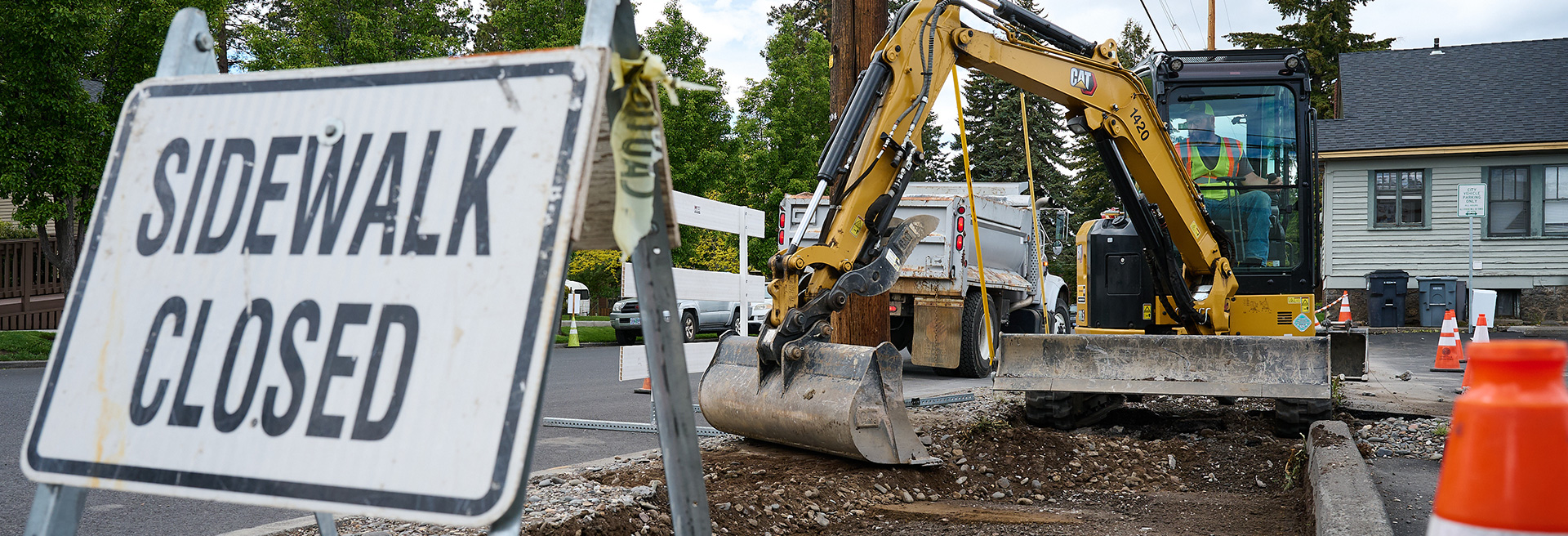
Understanding the right-of-way and easements is essential in the permitting process. Right-of-way refers to land managed by the public for transportation and utility purposes. Public easements are rights granted by property owners to the public or specific entities to use their land. These easements, such as those for public utilities, stormwater management, or access, allow for the installation, maintenance, and repair of equipment on private property.
All work referenced on this page will need to be performed with a Qualified Right of Way Contractor. Learn more about what that means on our Qualified Right-of-Way Contractor webpage.
Guidelines and Requirements
When You Need a Permit
You need a Right-Of-Way (ROW) permit if you plan to do any work within the right of way or public easement. Traffic control permits are also required where pedestrian, bike or vehicular traffic is impacted. We review Right-of-Way permits based on City Standards and Specifications, including the Bend Code.
Traffic Control Plans
We review Traffic Control Plans according to the Manual on Uniform Traffic Control Devices (MUTCD) for Streets and Highways – Oregon Supplement to the 2009 Edition and the Oregon Temporary Traffic Control Handbook (OTTCH) for operations lasting 3 days or less.
Permit Tiers and Plan Levels
The Right-Of-Way Permit Tier (Tier 1, 2, or 3) and Traffic Control Plan Level (Level 1, 2, or 3) depend on your proposal.
- Tier 1 (No Street Cut) Permits are needed for projects with low impact, where work is planned in areas like a landscape strip or unimproved area.
- Tier 2 (Street Cut) Permits are required for projects with medium impact, where work is planned for improved paved areas or where an existing sewer/water main is being tapped for services.
- Tier 3 (Infrastructure) Permits are necessary for projects with high impact, where work is planned to be complex and will involve multiple block franchise utility installations or public infrastructure is being constructed and will be accepted and maintained by the City of Bend.
While we provide guidelines for the expected level of review, we might change the review level based on the scope or changes to your proposal.
Franchise Utilities
Franchise utilities can maintain their facilities on private property within private easements (outside public access or public utility easements and right-of-way) without needing a Right-Of-Way permit. All franchise utilities within public utility easements or right-of-way require a right-of-way permit.
Tier 1 ROW Permit – Low Impacts
We issue Tier 1 ROW permits, also referred to as No Street Cut ROW permits, when work is planned in a landscape strip or an unimproved area. However, you cannot do street cuts, curb cuts, or pavement restoration with a Tier 1 permit.
You need a Tier 1 ROW permit for the following types of work:
- Installing franchise utilities in a landscape strip or an unimproved (unpaved) area that isn’t in a public easement.
- This includes things like natural gas lines, power lines, communication lines, and the like.
- Installing sidewalks.
- Installing driveways that do not impact a curb (curb cut is already existing).
A Right-Of-Way permit is required for all sidewalks and driveway aprons within the right-of-way or a public access easement. This ensures they meet accessibility requirements.
Tier 2 ROW Permit – Medium Impacts
We issue Tier 2 ROW permits, also referred to as Street Cut ROW permits, for work in improved (paved) areas. This includes street cuts, curb cuts, pavement restoration and any service taps from water or sewer mains, which are expected and allowed under this permit. Most work under a Tier 2 permit doesn’t need an engineered design, except for curb ramps and alley improvements. However, we might request an engineering design depending on the complexity of the project.
You need a Tier 2 ROW permit for the following types of work:
- Installing utilities (2 inches or less for water or dry utilities, and 6 inches or less for sewer) in a paved area within the right-of-way or a public easement.
- Street cuts and pavement restoration.
- Installing curb ramps.
- Driveways or alley approaches if they impact a curb.
- Paving streets or alleys without curbs or stormwater systems.
- Abandoning public infrastructure.
- Installing water services (2 inches or less) and sewer services (6 inches or less).
- Using boring or other trenchless technology for less than one city block or 350 feet, whichever is shorter (requires a boring profile).
Tier 3 ROW Permit – High Impacts
We issue Tier 3 ROW permits, also referred to as Infrastructure permits, for complex projects that extend utilities over long distances or that involve public infrastructure to be accepted and maintained by the City of Bend.
You need a Tier 3 Infrastructure permit for the following types of work:
- Franchise utility installations over 350 feet, with more than 3 utility crossings, or infrastructure larger than 2 inches in diameter.
- Public sewer or water main installations (any length) and related equipment (maintenance holes, valves, hydrants, etc.).
- Installing water/fire sprinkler services 4 inches.
- Storm infrastructure (e.g., catch basins, sedimentation manholes, drywells, storm pipes, etc.).
- Installing fire vaults in the right-of-way or within a public easement.
- Directional drilling, boring, or other trenchless technologies that:
- Are longer than 350 feet.
- Cross 3 or more utilities (City and Franchise).
- Cross under bridges or canals.
- Cross under high-pressure gas mains or other critical utilities.
- Cross under railroad tracks.
- Cross under rivers or streams.
- Require more permit review and inspections than a standard Tier 2 permit.
Traffic Control Plans
You need a Traffic Control Plan (TCP) for any proposal that affects vehicle, bike, or pedestrian traffic. This includes special events in the right-of-way that impact traffic.
We have three levels of traffic control review:
- Level 1 TCP: For low impacts to the city system, usually on a local road.
- Level 2 TCP: For medium impacts to the city system, typically on a collector or arterial road.
- Level 3 TCP: For high impacts to the city system, requiring a stamped, engineered plan.
Required Review Process
1Step: Prep & complete required permit application documents
Prior to submitting for your permit, complete the following items. These will be submitted with your application.
- Traffic control Plan
- Site Plan
Be sure to include on your site plan:- Addresses, parcel numbers, property lines, easements, and streets within and around the work area (150 feet)
- Scale, north arrow, and legend
- Location of existing infrastructure (curbs, driveways, sidewalks, curb ramps, water and sewer mains, meters, valves, vaults, hydrants, maintenance holes, franchise utilities, power poles, etc.)
- Location of structures or landscaping within the work area (buildings, sheds, retaining walls, fences, trees, etc.)
- Proposed improvements or street cuts
- Limits of pavement restoration for streets or other infrastructure (curbs, driveways, etc.)
- Dimensions showing separation, clearance, length, width, etc., for existing and proposed infrastructure
- Roadway widths, depths, and centerlines
- Reference applicable City Standard Drawings
- Contour lines if over 20% slope
- Erosion control measures (if required)
- Add clear vision areas
- Miscellaneous uploads
- Utility locate number when excavating with the right of way or public easement
- Pictures of the work area. Where locates were performed, pictures should reflect the locates
- All applicable City standards required for the improvement(s)
2Step: Submit Tier 1 or Tier 2 Right-Of-Way Permit Application
- In the Online Permit Center Portal, under choose the application type, select “ROW”
- Complete the rest of the form and submit the application
- Be sure to have all previously completed items from Step 1 above ready to upload to the application
- Pay the permit fees
3Step: Permit Review and Issuance
- Our team will complete the necessary reviews of your application.
- If corrections are required, our team will issue a corrections letter with mark ups on the submitted plans.
- If everything passes our reviews, we issue the permit and Right-Of-Way packet with inspection information.
- Applicants must provide all applicable City Qualified contractors / subcontractors on the permit prior to issuance. The contractors can be added to the permit upon application submittal or by separate upload document.
4Step: Schedule and Complete Inspections
- As work is being done on your project, be sure to schedule inspections along the way per the inspection information included with your Right-Of-Way packet.
- All inspections must be passed for the project to be completed and compliant with all regulations.
- Please schedule your inspection the day before it is needed.
1Step: Prep & complete required permit application documents
Refer to our Tier 3 (Infrastructure) Right-of-Way Permit Submittal Checklist for a detailed checklist of all items that will be required for this permit.
Prior to submitting for your permit, complete the following item. This will be submitted with your application.
- Engineered Plans
- Infrastructure engineered plans must be designed and stamped by a professional engineer and submitted per the City of Bend Standards and Specifications.
2Step: Submit Tier 3 Infrastructure Permit Application
- In the Online Permit Center Portal, under choose the application type, select “Infrastructure.”
- Complete the rest of the form and submit the application.
- Be sure to have the previously completed item from Step 1 above ready to upload individual sheets to the permit.
- Pay the initial permit review fees.
- Fees are based on sheet count. When requested by the applicant, we can review the sheet count and fees prior to review to prevent overpaying or that the applicable permit(s) per applied. No review will be conducted to the submittal until the application fees are paid.
3Step: Permit Review
- Our team will complete the necessary reviews of your application.
4Step: Pay Final Fees
Final fees include inspection fees, document preparation fees, recording fees, and the like.
- Once everything passes our reviews, final fees will be ready to be paid.
- Login to the Online Permit Center Portal.
- Locate your application under My Items.
- Click the button ‘Add fees to my Cart.’
- Proceed to the Shopping Cart and complete payment for the fees amount.
5Step: Complete Additional Required Items
- Additional required items can include easements, Public Facilities Improvement Agreements (PFIA), and more. If you have questions on what additional items are required, please contact our Private Development Engineering Division: engineering@bendoregon.gov or 541-388-5580 Ext. 4.
6Step: Pre-Construction Meeting
- All City Qualified contractors/subcontractors must be identified prior to the pre-construction meeting.
- Our team will schedule and host a pre-construction meeting prior to commencing construction on your project.
7Step: Permit Review and Issuance
- After steps 1-6 are complete, we issue the permit, Notice to Proceed (NTP) with inspection information. No construction is permitted without a NTP letter sent by the city.
8Step: Schedule and Complete Inspections
- As work is being done on your project, be sure to schedule inspections along the way per the inspection information included with your Notice to Proceed and within the approved plans.
- All inspections must be passed for the project to be completed and compliant with all regulations.
9Step 9: Final Items and Warranty Bond Issuance
- City inspector issues a punch list of items that need to be finalized.
- Provide information for our staff to prepare a 1-year warranty bond, asset transfer, as builts, Engineering certifications and/or performance bond to the City of Bend. These are requested when the project gets to project substantial completion – when the project has been deemed complete.
- A city inspector and city review engineer will sign off to begin the 1-year warranty.
10Step: 1-year Warranty and Fix Punch List Items
- Inspector conducts a final inspection after approximately 10 months after substantial completion to verify workmanship. Failures to the project’s infrastructure will be requested through a final punch list.
- Completion of the final punch list will close the permit and grant the release of the warranty bond and the PFIA.
Submission Period for Traffic Control Plans for Special Events
- Be sure to submit a Traffic Control Plan for a NEW special event at least 90 days in advance
- Be sure to submit a Traffic Control Plan for a REPEAT special event at least 30 days in advance.
1Step: Prepare and complete required application documents
If your Right-of-Way Permit or Special Event Requires a Traffic Control Plan, prior to submitting your application, prepare a plan sheet. All of these items should be included in a single PDF file:
- Addresses and Parcel Numbers: Include property lines and streets within 150 feet of the work area.
- Traffic Control Plan: Show the overall route and area affected.
- Map Details: Include a scale, north arrow, and legend.
- Street Information: List street names and widths.
- Existing Traffic Control: Note speed limit signs, stop signs, road striping, etc.
- Traffic Signals: Describe any changes, like bagging lights or switching to flashing red.
- Traffic Control Devices: Show where cones, barricades, warning signs, and Portable Changeable Message Sign boards will be.
- Detour Routes: Plan for pedestrians, bicycles, and vehicles.
- Sidewalk and/or Bike lane Closures: Indicate any closures.
- Buffer Zones: Include buffering distances.
- Parking: Show parking areas and any restrictions.
- Lane Changes: Note revised traffic lane dimensions.
- Traffic Control Schedule: Provide a schedule for traffic control devices.
- Flaggers and Volunteers: Show where certified flaggers and/or volunteers will be.
- Implementation Dates and Times: If known, include when the Traffic Control Plan will be in effect.
2Step: Submit Traffic Control Plan with Your Application
Traffic Control Plans are submitted as part of specific Right-Of-Way Permits and some Special Event Permits. The item completed in Step 1 above will be uploaded as a submittal during the application process.
For detailed information on applying for and submitting a Right-Of-Way Permit:
For detailed information on applying for and submitting a Special Event Permit:
Have Questions? Need Help?
Contact the Private Development Engineering Division at engineering@bendoregon.gov or 541-388-5580 ext. 4.

Customer Resources:
Monday through Friday
8 a.m. – 5 p.m.
Permit Inquiries:
Monday through Friday
9 a.m. – 4 p.m.
Closed most major holidays.

Location:
710 NW Wall Street
Bend, OR 97703