Roundabouts – A Safer Intersection Design
Roundabouts efficiently manage traffic volumes and improve safety for all types of users, including drivers, cyclists and pedestrians. No wonder we have about 50 of them!
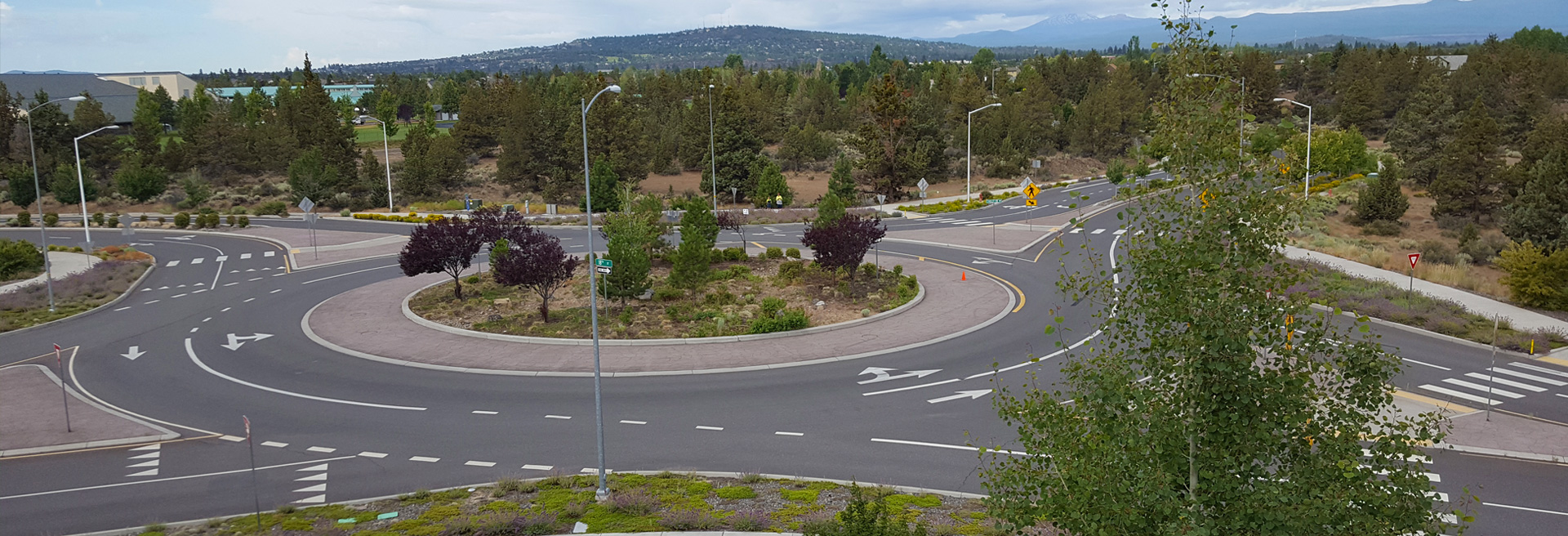
A roundabout, also known as a traffic circle, is a circular intersection where drivers travel around a central island in one direction. Instead of stopping at traffic lights or stop signs, vehicles yield to traffic already in the circle, making it safer and more efficient. Roundabouts reduce the likelihood of serious accidents because they eliminate head-on and high-speed collisions. They also keep traffic moving smoothly, which can help reduce congestion and pollution.
Frequently Asked Questions
No, your vehicle may not block the passage of vehicles at an intersection. Ensure there is sufficient space within and beyond the intersection to accommodate your vehicle without blocking traffic. If traffic has slowed or stopped in the roundabout to such an extent that you would block traffic, do not proceed to enter the roundabout.
First, practice defensive driving like you would at any other intersection. Second, be sure to follow all the yield rules yourself. By setting a good example, other drivers will learn by watching you. If a driver in the circulatory roadway stops for you to enter, refuse to take them up on their offer. By following the yield-at-entry rule, other drivers will eventually learn.
Yes, Oregon law requires drivers to signal their exit from roundabouts.
No, you should not change lanes in an intersection, and roundabouts are no exception. Determine your lane before you enter the intersection.
No, if you find you are in the wrong lane to exit where you want, use the proper exit for the lane in which you are traveling.
Absolutely, and just like stop signs and stoplights, it is important for drivers, pedestrians and cyclists to learn the rules for roundabouts.
All modern roundabouts have pedestrian refuges, called splitter islands, to separate entering and exiting traffic flows, and marked crosswalks. Pedestrians should cross only at the crosswalks. The splitter island allows pedestrians to cross halfway and concentrate on traffic approaching from one direction at a time. Pedestrians have the right of way over other vehicles, meaning drivers should yield to pedestrians in the crosswalks. Pedestrians need to determine when it is safe to cross and pick a safe gap in traffic. Wait for traffic to stop before crossing and make sure drivers are aware you are crossing.
People have a legal right to ride their bicycles with traffic when traveling through single-lane and multilane roundabouts, just like other intersections. Riding through a single-lane roundabout presents less exposure to vehicles compared to riding through a multilane roundabout. To use the travel lanes, take the lane and ride in the center of the travel lane. Ride defensively, as drivers may not see you. Follow the rules of the road, obeying all lane assignments. Enter the roundabout at appropriate speeds, yielding to traffic in the roundabout. If you prefer to use the shared-use sidewalk, use the bike ramp to access the sidewalk, slow down to walking speed or walk your bike, use the crosswalks, and cross in two stages using the splitter island.
Truck aprons are added to roundabout designs to accommodate large truck turning movements. Sometimes truck aprons are located on the outside of the circle to accommodate trucks making wide right turns, but mostly they can be seen on the inside of the circle to accommodate left turns. Trucks should use the truck aprons whenever they are provided. In multilane roundabouts, trucks will need to use more than their lane to accommodate wide turns. Drivers and bicyclists should never drive alongside large trucks due to this potential for large trucks to cross into adjoining lanes. Trucks should take both lanes when entering a roundabout to ensure that drivers will not try to drive alongside.
The only priority rule at roundabouts is that entering drivers must yield to those already in the roundabout. Every entrance has a yield sign to remind entering drivers of this responsibility.
A driver at an all-way stop is required to stop before entering the intersection and yield the right of way to any other vehicles that pose an immediate hazard. At roundabouts, drivers are required to yield the right of way to all circulating vehicles, which may or may not require them to stop before entering the intersection.
Roundabouts are not like four-way stops. You do not get a turn to go. You may only enter the roundabout when there is a safe gap in the traffic flow.
It depends on the amount of traffic already in the roundabout. When there is a lot of traffic, you will probably have to stop. Ideally, however, you should try to judge a smooth entry into the traffic stream without stopping. You should always be traveling slowly enough to stop for pedestrians and other traffic, as necessary.
Single-lane roundabouts are designed for speeds less than 15 to 20 mph due to their turning radii, and traffic conditions may require even slower speeds than these. Multi-lane roundabouts have similar design speeds due to their geometry, but their speeds will vary more depending on traffic conditions. Drivers should proceed slowly enough to allow entry drivers the ability to take advantage of gaps in the traffic stream to enter the roundabout smoothly and efficiently. Drivers should drive slowly enough to be able to stop at any time for pedestrians or other traffic.
You will have to use your own judgment based on the vehicle you are driving, the weather conditions, and traffic flow around you. It is always your responsibility to select a safe gap before you cross your yield line.
The goal of a roundabout is to keep traffic flowing smoothly and efficiently by having everyone drive at a consistent speed, making it easier for drivers to merge and use gaps efficiently, which increases capacity and reduces delays. You should not stop in the circulatory roadway to let another vehicle enter; the only rule is “yield-at-entry.” For emergency vehicles, clear the intersection before pulling over to the right and stopping, either by stopping before entering the roundabout at the yield line or by pulling through and stopping after clearing the intersection.
Be patient and wait for them to go first. Do not change lanes within the roundabout. With more experience, drivers will gain confidence and stop less frequently inside the roundabout.
Be patient and wait for them to choose their safe gap. Try to avoid honking your horn because it tends to cause timid drivers to make mistakes.
No, your vehicle may not block the passage of pedestrians at an intersection. Ensure there is sufficient space on the other side of the marked crosswalk before you move forward to occupy that space.
Educational Activity Book
This activity book introduces children to roundabouts, teaching them how to walk and bike safely through and around these increasingly popular intersections. Download the book to learn more!