Tree Regulation Code Update
The Bend City Council has adopted new rules to regulate how trees should be preserved with new development.
The Bend City Council’s goals continue to include reviewing current tree regulations and considering amending them to respond to concerns from the community while also implementing strong policies favoring housing production. In March 2023, the Bend City Council began the process to find new ways to balance the need to preserve trees with needed housing development. A temporary committee, known as the Tree Regulation Update Advisory Committee, made a series of recommendations to accomplish this goal.
In June 2024, the Council adopted the new standards outlined below.
What To Know
On a very high-level, the new regulations spell out four main options for development greater than one (1) acre:
New Regulations
The amended code provides clear and objective tree protection standards for larger new developments that balance the need for housing production, housing affordability, and natural resource preservation. The amendments are largely informed by the recommendations made by the temporary Tree Regulation Update Advisory Committee. The highlights of the tree preservation amendments include:
Applicability
- Land division application.
- Site Plan Review application.
- Exception: Land division and Site Plan Review applications on sites one acre or smaller may choose to either comply with the tree preservation requirements or provide mitigation.
- Exemption: Applications one acre or less are exempt from regulations when they include residential development. No mitigation is required.
Size of Regulated Trees to be Inventoried and Mapped: 6” DBH or larger.
Clear and Objective Tree Preservation Options
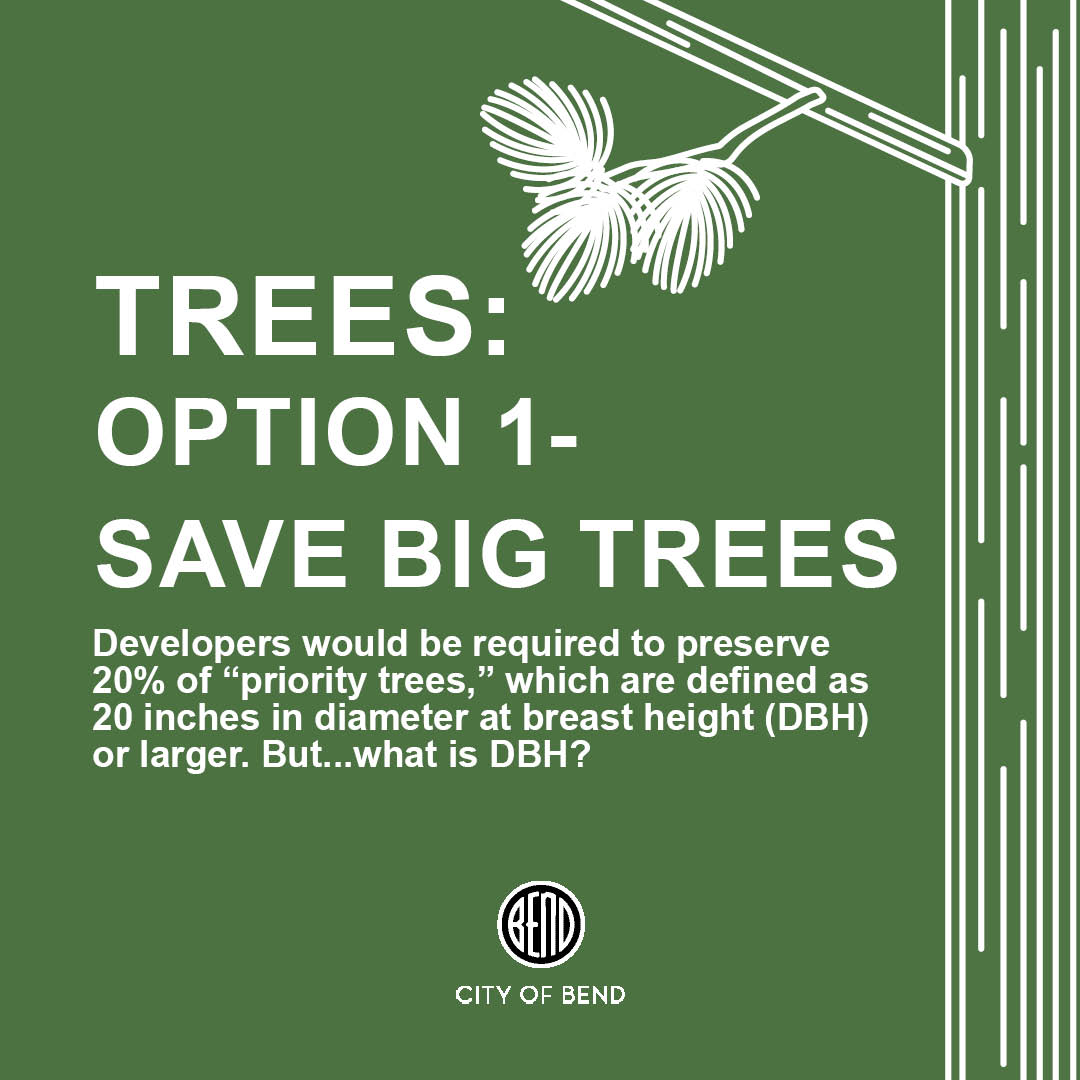
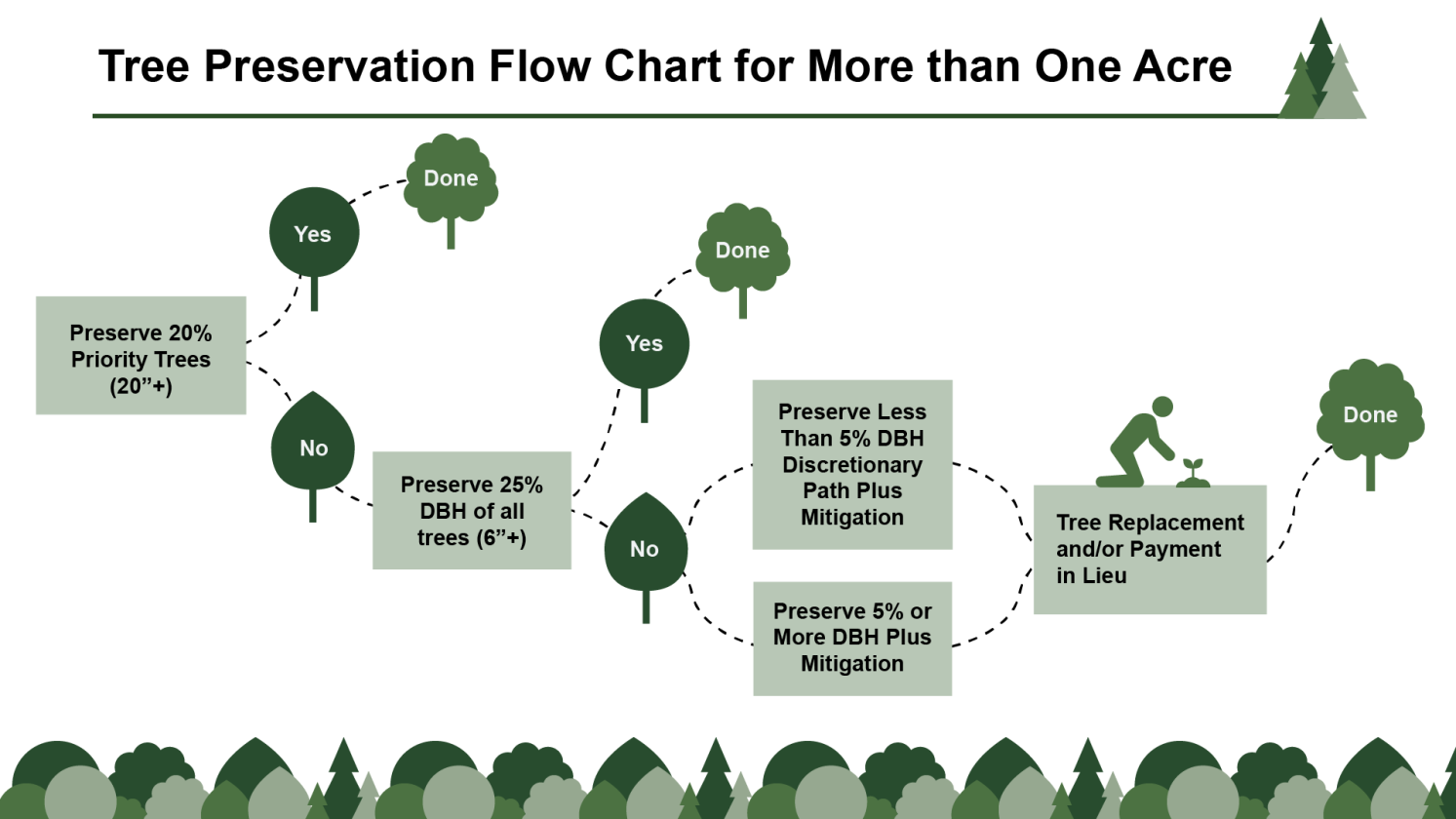
- Option 1. Preserve at least 20 percent of the Priority Trees (20” DBH or larger).
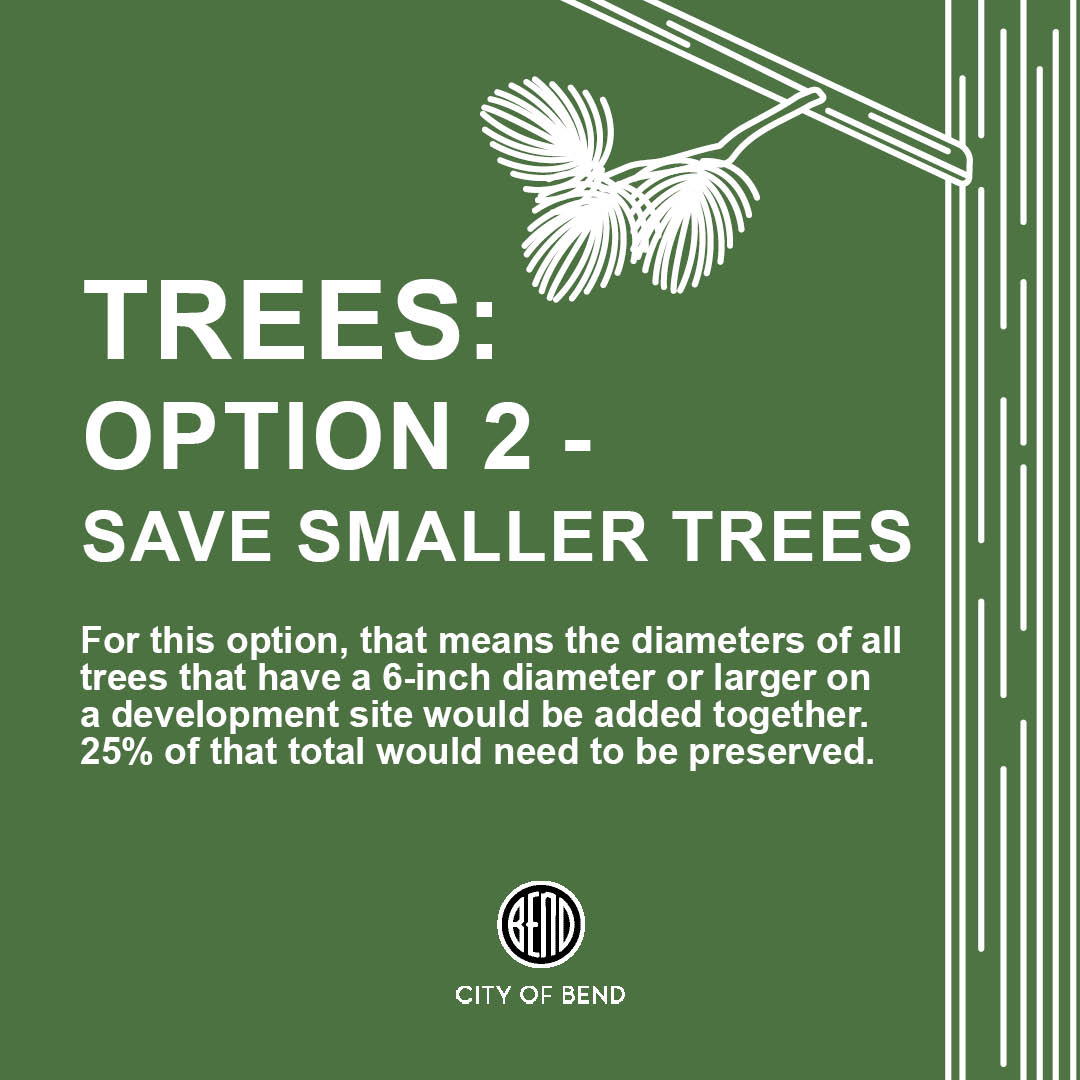
- Option 2. Preserve at least 25 percent of the total DBH of all Regulated Trees (6” DBH or larger).
- Option 3. Preserve at least 5 percent of the total DBH of all Regulated Trees, plus mitigate.
Discretionary Path
Option to apply for a discretionary path when the proposed development site has some existing constraints or adherence to Development Code requirements or Standards and Specifications makes it infeasible to preserve at least 5 percent of the total DBH of all Regulated Trees. If the request for a discretionary path is approved, mitigation will be required.
There will also be a discretionary track option for the Industrial Zones: General Industrial District (IG) and Light Industrial District (IL) Zones. The removal of trees is necessary to construct large level sites to accommodate industrial, commercial (not including small-scale personal and professional services), and public and institutional uses.
Mitigation Options
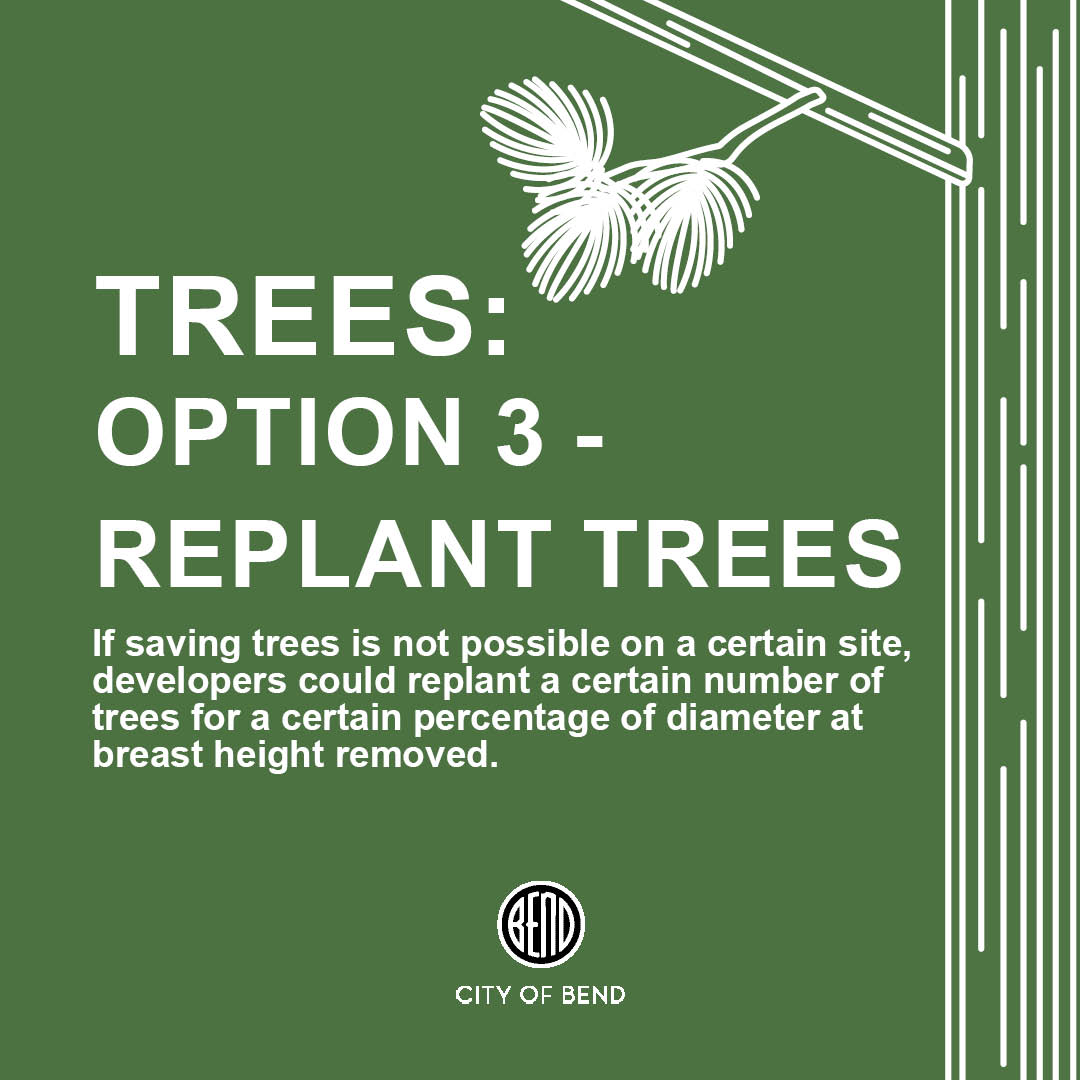
Tree Replacement Ratio. Mitigation trees are required on-site to make up for anything less than preservation of 25 percent of the total DBH of all Regulated Trees. The mitigation required to meet the standard is based on the largest tree or trees proposed for removal that equal or exceed the required DBH. The following is the tree replacement ratios:
-6″ to 9.9” DBH: One Tree
-10″ to 19.9” DBH: Two Trees
-20” DBH or larger: Four Trees
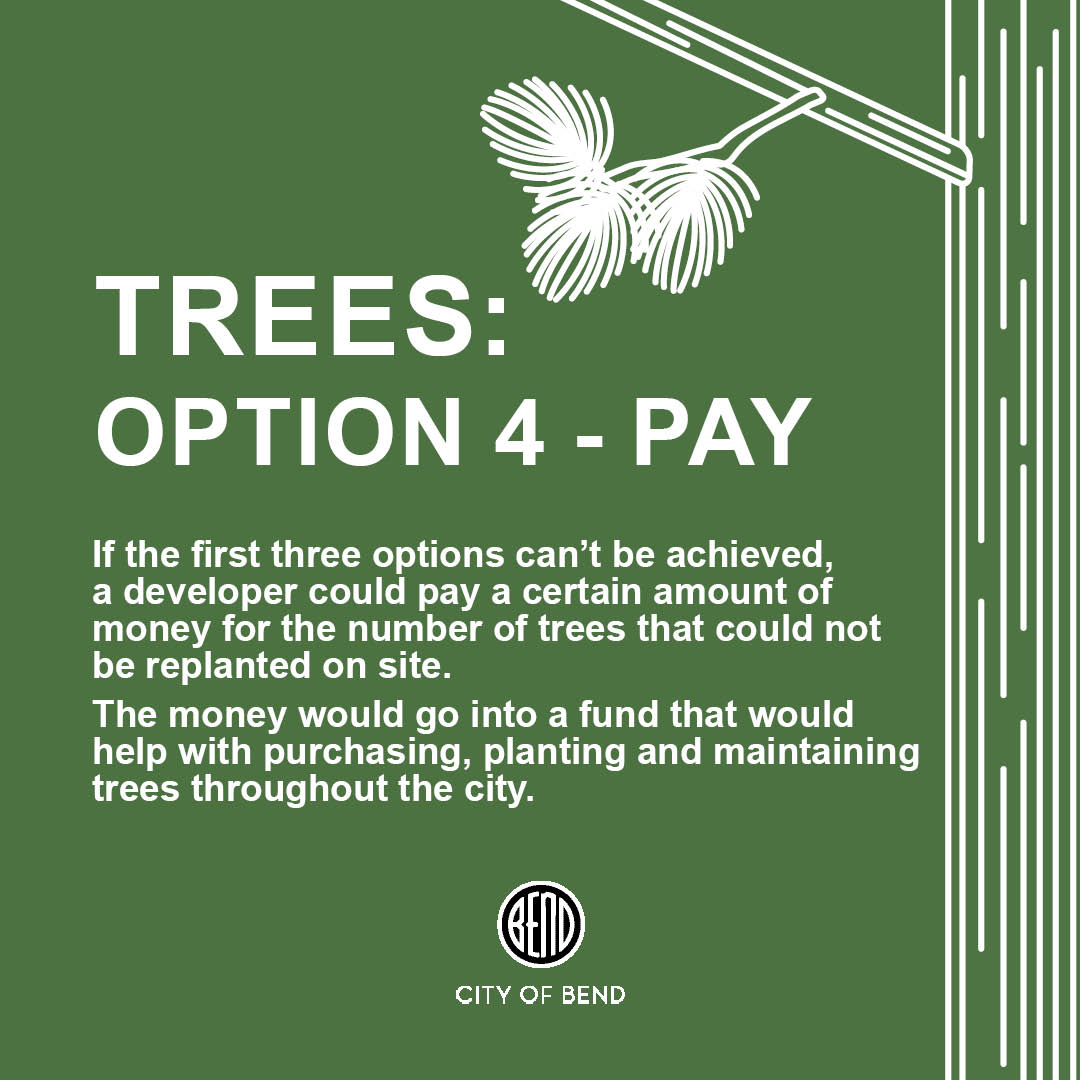
Payment In-Lieu of Tree Preservation
A payment in lieu of tree preservation must be made for each replacement tree required but not planted on-site. The amendments update the street tree requirements and add a requirement for water efficient planter strip landscaping. The amendments include revisions to other sections of the BDC for consistency and clarity.
Planning Commission and City Council Meetings
Public hearings for this item have concluded.
Meetings & Materials
Frequently Asked Questions
City Council formed a temporary committee called the Tree Regulation Update Advisory Committee to help develop potential amendments to City codes and standards to protect trees while balancing housing affordability and natural resource preservation.
Between June and December of 2023, the Tree Regulation Update Advisory Committee, also known as TRUAC, met to advise staff on amendments before making a recommendation to the Council.
Council appointed the following members at the June 21, 2023, City Council meeting:
- Kathy Austin – Affordable Housing Advisory Committee, architect
- Kavi Chokshi – Environment and Climate Committee
- Manoj Alipuria – Human Rights and Equity Commission
- Gina Franzosa – River West Neighborhood Association
- Brett Huett – Arborist
- Chris Madison – Arborist
- Cory Bittner – Pahlisch Homebuilders
- Morgan Greenwood – Central Oregon Builders Association
- Erik Huffman – Civil Engineer
- Geoff Harris – Solaire Homebuilders
- Corie Harlan– Central Oregon Land Watch
- Karon Johnson – Old Farm Neighborhood Association
- Jim Roberts – At Large
- Dan Jenkins – Landscape architect
In addition, three non-voting members will serve as liaisons to the committee:
- Megan Perkins, Bend Mayor Pro-Tem
- Sara Anselment, Bend Parks and Recreation District
- Sue Gordhammer, Bend Planning Commission
- Developers would be required to preserve 20% of priority trees, which are defined as 20 inches in diameter or larger.
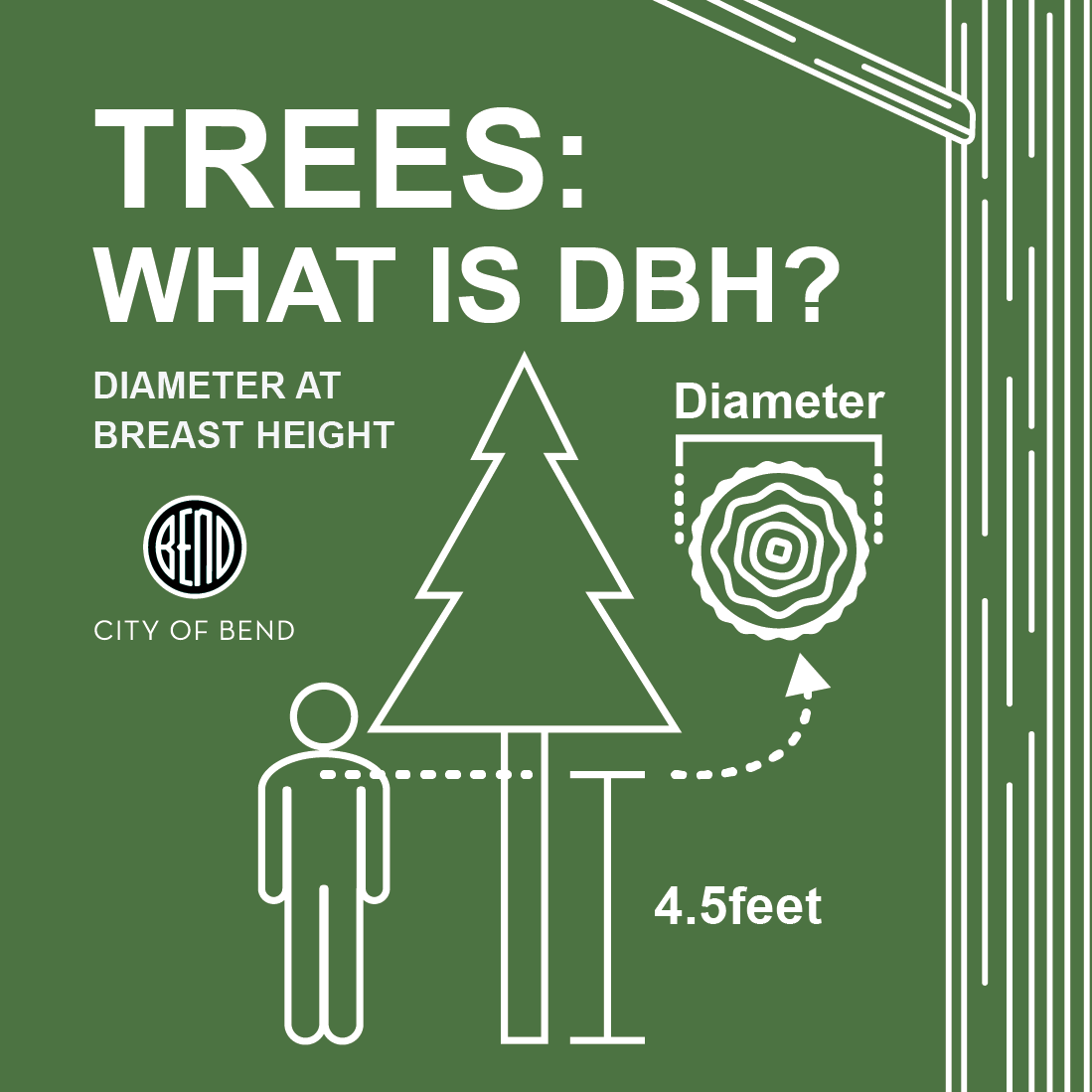
- Another option for developers is to preserve 25% of what is called the total “diameter at breast height” on a site. Diameter at breast height is the measurement of a tree’s diameter measured at 4 ½ feet off the ground. For this option, that means diameters of all trees that have a 6-inch diameter or larger on a development site would be added together, and 25% of that total would need to be preserved.
- If saving trees is not possible on a certain site, developers would have the option to replace a certain number of trees for every tree that was removed from the site. Bigger trees that were removed would require more trees to be planted in its place.
- If none of these options can be achieved, a developer may pay a “fee-in-lieu,” meaning the developer must pay a certain amount of money to mitigate for a certain number of trees. The fund would help with purchasing, planting and maintaining trees throughout the city.
- In general, developers would be required to preserve at least 5% of the total diameter at breast height of trees 6 inches or greater on a site.
The Council largely adopted the recommendations made by the Tree Regulations Update Advisory Committee. The Council adopted the following additional changes in response to community input:
- The addition of the discretionary track option for the Industrial Zones: General Industrial District (IG) and Light Industrial District (IL) Zones. The removal of trees is necessary to construct large level sites to accommodate industrial, commercial (not including small-scale personal and professional services), and public and institutional uses.
- Struck the Southeast Area Plan incentives consistent with staff’s presentation to the Planning Commission in order to have consistent citywide standards.
- Included land division final plat approval along with building final inspection as triggers for the three-year preservation condition of approval.
- Exempted residential developments on sites 1 acre or smaller from all tree preservation requirements including mitigation.
Council also generally supported additional discussion and research on best practices on the use of incentives to preserve trees on-site, reviewing the impact of the code on the production of housing projects and assessing how the four options and adopted incentives are being used, based on data, to determine whether the code as adopted is reaching Council and community objectives.
These rules apply for new development on land larger than 1 acre. New development on smaller properties wouldn’t be required to save a certain percentage of trees.
In addition to the amendments to the Bend Development Code, there are amendments proposed to Bend Municipal Code (BC) Title 3, Rights-of-Way and City Property and to BC Title 16, Grading, Excavation, and Stormwater Management. The proposed amendments create BC Chapter 16.40, Tree Preservation and Removal to provide consistency with the proposed amendments to the Bend Development Code for tree preservation.
In addition, the amendments create BC Chapter 16.35, Erosion Control Requirements to comply with the City’s National Pollutant Discharge Elimination System Municipal Separate Storm Sewer System Permit.
For questions about BC Chapter 16.40, please contact Pauline Hardie at phardie@bendoregon.gov and for questions about BC Chapter 16.35, please contact Elisabeth Okeefe at eokeefe@bendoregon.gov.
A public hearing will be held July 17 before the Bend City Council.
- Require street trees for single-unit detached dwellings, townhomes, duplexes, triplexes, quadplexes, single room occupancies with six or fewer units and cottage cluster developments when there is existing sidewalk or a sidewalk is required with the development.
- Update and expand list of allowable street trees based on planter strip width.
- Relocate the City of Bend Approved Street Tree List from the BDC to Appendix D of the City of Bend Standards and Specifications.
The most up-to-date information about landscaping in planter strips located in the right-of-way can be found on our Tree Preservation and Planter Strip Landscaping webpage.
Urban Forestry
Urban Forestry is a program which supports a thoughtful balance between protecting trees and making space for housing. The focus is on carrying out tree preservation guidelines to help maintain a healthy and sustainable environment as our community grows.