Educational Program: Our Water System
Take a journey through Bend’s water system. Learn where the City of Bend water comes from, who uses it, and where it goes after it is used. Learn how it is treated and how you can conserve and protect this vital resource.
The full program includes a complete series of four lessons, plus bonus materials. To begin, watch the introduction video below, then click on Lesson 1A and learn about Bend’s “One Water” cycle.
Learning Objectives
- To understand what a watershed is and can locate and identify our watersheds.
- To be able to explain our two water sources.
- To be able to analyze connections between local water users and how we use water.
- To be able to make choices and take actions to keep our watershed healthy.
Vocabulary List
-
Watershed: An area of land that drains water, over land or underground, to the same place, such as a stream, river or even the ocean. Each watershed is determined by its topographic boundaries. Gravity ensures water flows from high point to low point. Some watersheds are small and some are big.
-
Sub-basin: Watersheds can be subdivided into smaller units known as “subwatersheds,” which flow together to form larger sub-basins and “river basins.”
-
Groundwater: Water located beneath the ground that fills empty spaces, like cracks and spaces in soil, sand and rock. It is stored in and moves slowly through geologic formations of soil, sand and rocks called aquifers.
-
Surface Water: Surface water is water that collects above ground, including streams, rivers, lakes, wetlands, reservoirs, creeks and oceans.
-
Runoff: Rain or snow/ice melt that does not soak into the ground becomes runoff and can carry soil, pollutants, and other materials from the land into our river or toward our underground water supplies.
Watersheds
- Watch this two-minute video:
- Read Our Watersheds to identify and locate our watersheds.
Exercise
Find our Upper Deschutes watershed address on the USGS interactive website and note the 8-digit address number.
Our Water Sources
Since 1926, water from the Bend Municipal Watershed has been the primary source of drinking water for City of Bend. When water demands increase during the summer because of outdoor landscape watering, groundwater must be pumped from the Deschutes Regional Aquifer to supplement our surface water supplies. Bend is fortunate to have these two water supply sources to meet peak season demand and use during emergencies.
- Bend Municipal Watershed
Our surface water source from high in the Deschutes National Forest is our primary supply all year. Prowell Springs is our source spring in the Bend Municipal Watershed. - Deschutes Regional Aquifer
During the summer months, when outdoor watering significantly increases demand, we must supplement our supplies with deep wells that pump groundwater from the Deschutes Regional Aquifer. Watch this short video and take note of the important interactions between groundwater and surface water.
Exercise
List and describe our two sources of water.
Water Users
Water is an important part of our lives in Central Oregon. Watch this “Sharing Water” video to learn about five types of Deschutes Basin Water Users. Which Water User(s) are you?
Exercise
To analyze connections between local Water Users, begin creating a list of how people in Bend use water. Which Water User(s) are you?
Keeping Our Watershed Healthy
- A healthy watershed is essential to life. Almost everything that happens on land has an impact on watersheds and the communities living in them. Humans have a major impact on watersheds. Watch the 3 minute video and take note of the impacts mentioned.
- In Bend, we are surrounded by beautiful forests and trees. Healthy forests and trees are a vital part of our water cycle and watershed. Watch this 2-minute video from OSU and take note of how trees transpire and also act like a sponge slowing the flow of water and allowing it to absorb into the ground.
- It’s all connected - Watersheds make up a large part of our earth’s water cycle (hydrologic cycle).
- How do watersheds get polluted? Living in a city, what can we do to help? It turns out, we can do a lot because the single greatest source of urban water pollution is the stormwater that runs off roofs, roads, parking lots and other hard surfaces every time it rains or the snow melts. Unlike pollution from industrial sources, stormwater is something that we all contribute to. That means each of us can take actions to reduce these impacts to our watershed. As you watch the 2-minute video below, make a list of the ways to reduce pollution and keep our watershed healthy.
Exercise
- Finish analyzing connections between local water users, how we use water and how we keep our watershed healthy.
- Which water user(s) do you relate to most?
- As a water user, list what you can do to reduce impacts to our watershed?
Bonus Exercise
Create a haiku about water use in Bend or about Bend’s Municipal Watershed.
Sample Haiku:
Water Haiku
Water flows downstream
from the mountain’s bubbling springs
Pristine watershed
Congratulations! You have completed Lesson 1.
In Lesson 2, we will explore the ins and outs of water to learn more about our water’s journey from the forest to your faucet, where it goes after you use it and stormwater features that can help protect this vital resource.
Learning Objectives
- To understand how clean water gets to your home and school.
- To know what happens to your used water after it goes down the drains in your home and school.
- To be able to explain what happens to rainwater and melting snow when it hits a hard (impervious) surface.
- To be able to make choices and take actions to reduce impacts of hard surfaces and help protect our water.
Vocabulary List
- Water Filtration Facility (WFF): Where City of Bend surface water is filtered and treated.
- Water Distribution System: A system of clean water pipes and valves that deliver fresh water to homes, schools and businesses.
- Wastewater (sewer) Collection System: All the wastewater/sewer pipes and pumps that collect and transport the used water from our homes, schools and business to the Water Reclamation Facility (WRF) for treatment.
- Water Reclamation Facility (WRF): Where Bend’s dirty/used water is “reclaimed” to be processed, cleaned, tested and safely returned to the water cycle.
- Stormwater Collection System: This system of pipes and features collect stormwater runoff. They are separated from the wastewater (sewer) pipes. Stormwater is NOT treated at the WRF.
A Quick Review of the Water Cycle
-
The sun drives evaporation from lakes and streams and transpiration from trees and plants.

-
Gravity causes precipitation to soak into the ground or flow downhill in the watershed.
-
Percolation is also driven by gravity and replenishes groundwater in the aquifer.
- Human use can pull water out or put water back into system!
Bend’s “One Water” Cycle
The “One Water” approach sees all water—drinking, wastewater, stormwater—as connected. This helps us manage and use water wisely and sustainably.
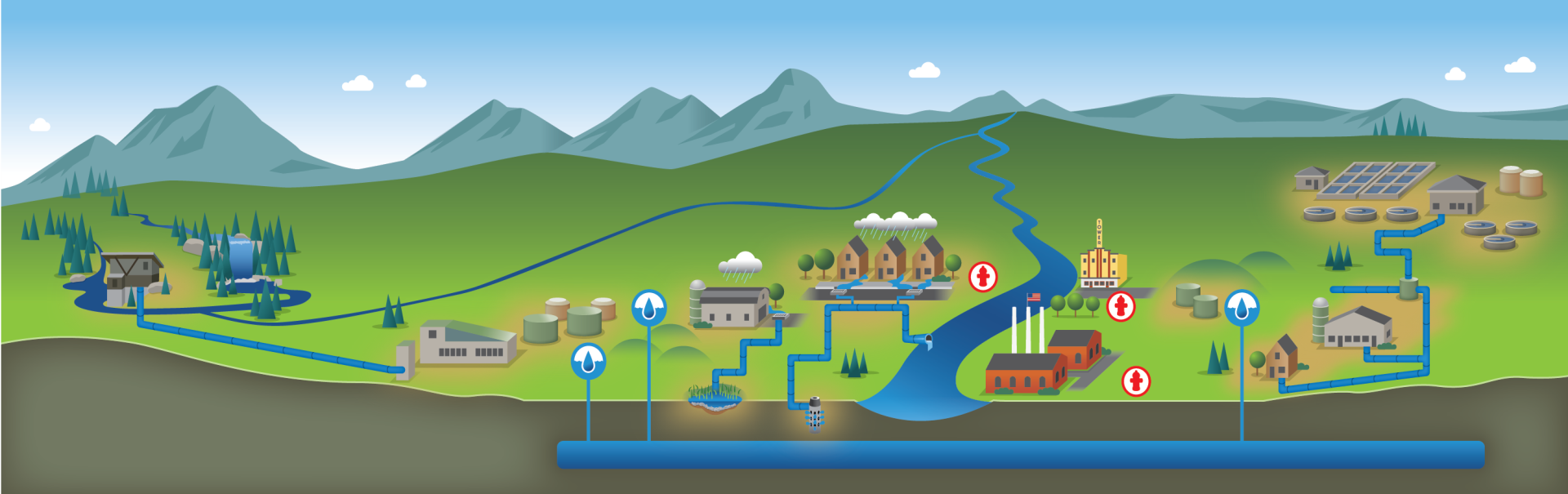
Keeping in mind what you already know about our earth’s water cycle, read the pop ups on the Bend water system graphic above to see how the water we use in Bend makes a journey through our local water cycle. The same descriptions are listed by number below.
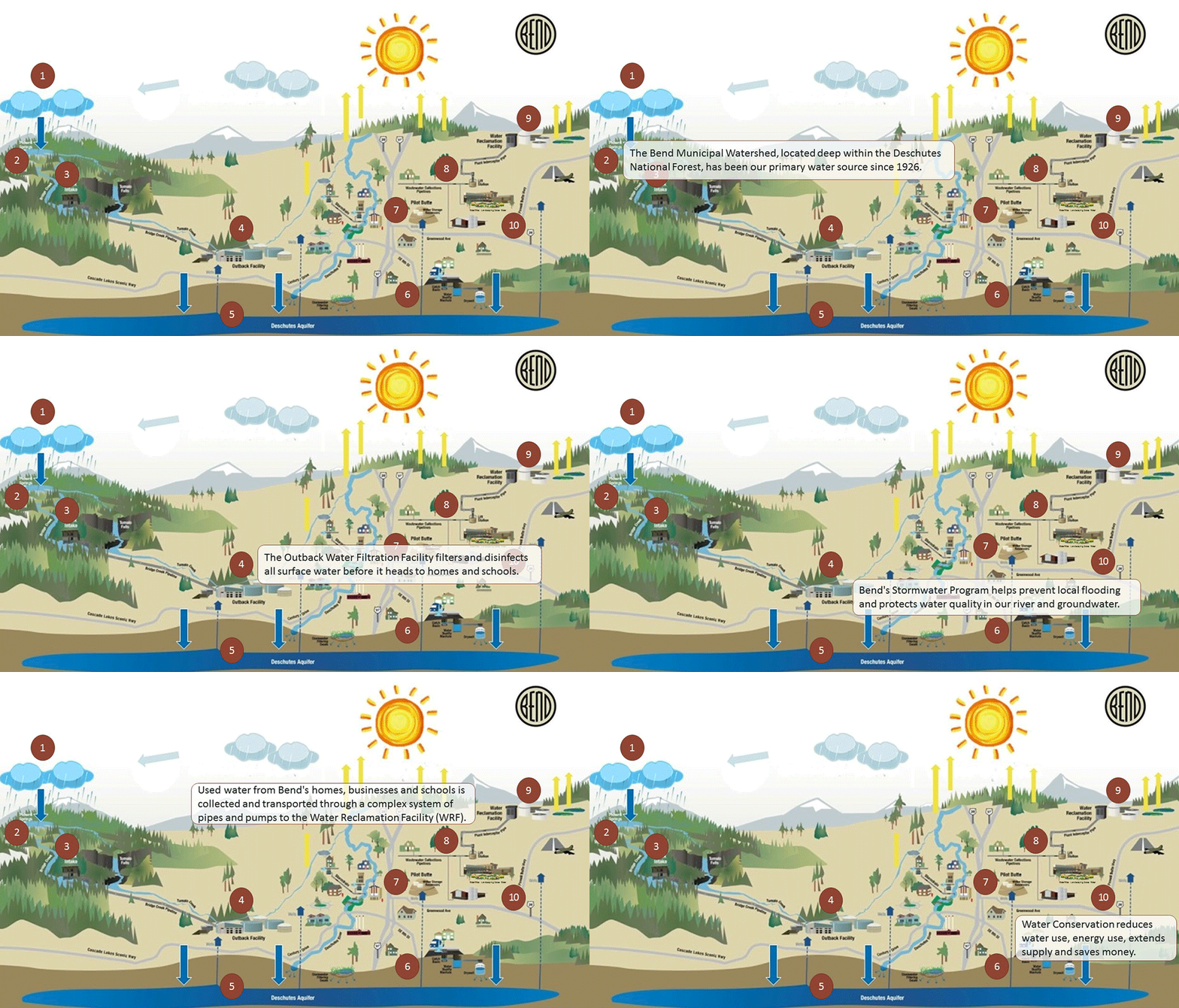
- We depend on rain and snowfall high in the Cascade Range to recharge Bend’s watershed and our regional aquifer.
- Bend Municipal Watershed, located deep within the Deschutes National Forest, has been our primary water source since 1926. (Optional: Learn more about Bend’s water history.)
- The Intake Facility measures the water as it flows into the pipe heading down to the Outback. Our surface water permit only allows the City to take a limited amount of water.
- The Outback Water Filtration Facility filters and disinfects all surface water before it heads to homes and schools.
- Groundwater is pumped from the Deschutes Regional Aquifer to supplement our water supply during the peak watering season. Peak season is when outdoor landscape watering creates very high demand.
- Bend’s Stormwater Program helps prevent local flooding and protects water quality in our river and groundwater.
- Water is stored in reservoirs throughout the City and the distribution system of clean water pipes and valves delivers fresh water to our homes, businesses, etc.
- Used water from Bend’s homes, businesses and schools is collected and transported through a complex system of pipes and pumps to the Water Reclamation Facility (WRF).
- The used water flows into the WRF and completes a series of processes that filter, separate, clean, test and disinfect the water before safely returning it to the water cycle.
- Water Conservation reduces water use, energy use, extends supply and saves money.
Bonus Fly-Over Tour
Explore Bend’s “One Water” cycle on Google Earth!
Note: Google Earth App is required for mobile devices.
Exercise
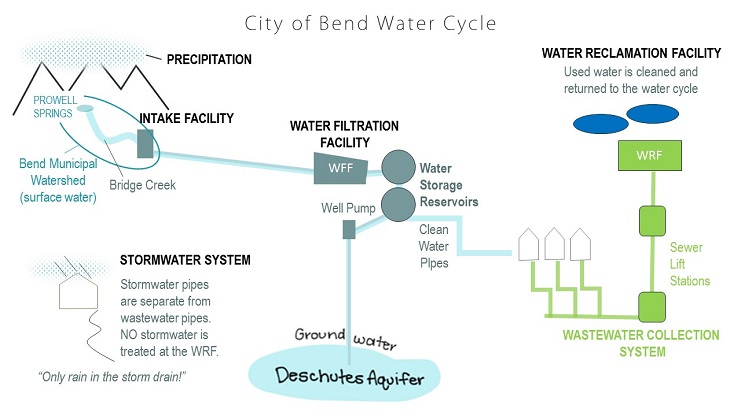
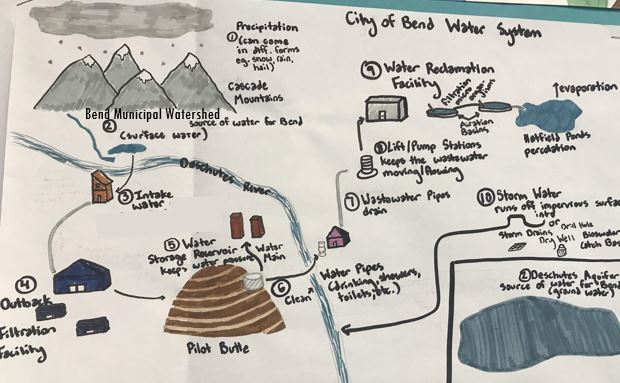
Draw a model of the path of water through Bend. Include and label parts 1-9 that you just learned about. Look at the sample drawings below to help you get started. (Do you see any mistakes or missing labels on the samples? Be sure to avoid those on your model.)
Bend’s Water Quality
Exceptional Sources are Just the Start.
Surface Water
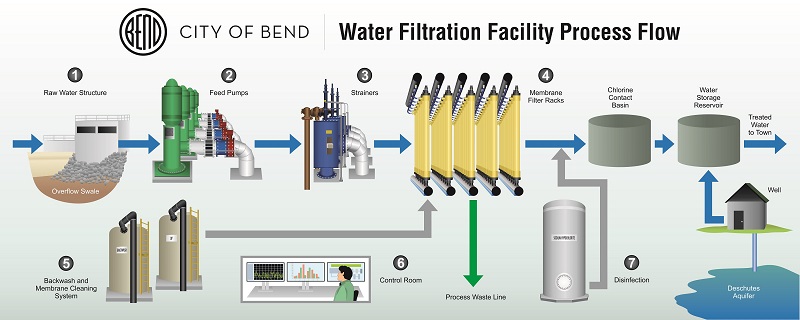
All surface water from Bend Municipal Watershed is treated at the Water Filtration Facility by membrane filtration, which removes pathogens (like cryptosporidium and giardia) and other particles too small for the naked eye to see. A small amount of chlorine is added to deactivate any viruses and bacteria while keeping our network of storage tanks and pipelines clean. The image below shows the surface water filtration process.
Groundwater
- Groundwater is naturally filtered by layers of soil, volcanic rock, sand and gravel.
- Small amounts of chlorine are added when the water is pumped to make it safe to drink.
Laboratory Testing to Ensure Safe Water
Our water is tested thousands of times each year to make sure it is safe to drink. What does this mean for you? Great tasting water, 24 hours a day, 365 days a year.
Optional: See Bend’s latest Annual Water Quality Report.
What is Stormwater
Stormwater is any water that collects on and runs off land. It sounds harmless, right? But as cities are built and grow, they become dense with buildings, streets, sidewalks and parking lots. Those hard surfaces prevent water from naturally absorbing into the ground. This creates fast-flowing stormwater runoff that collects a variety of pollutants, washing them down storm drains directly into the Deschutes River, or injecting them towards our groundwater supply.
Look at the images below and note the difference between the drainage in a natural area where water can be absorbed and an area with hard surfaces from traditional development.
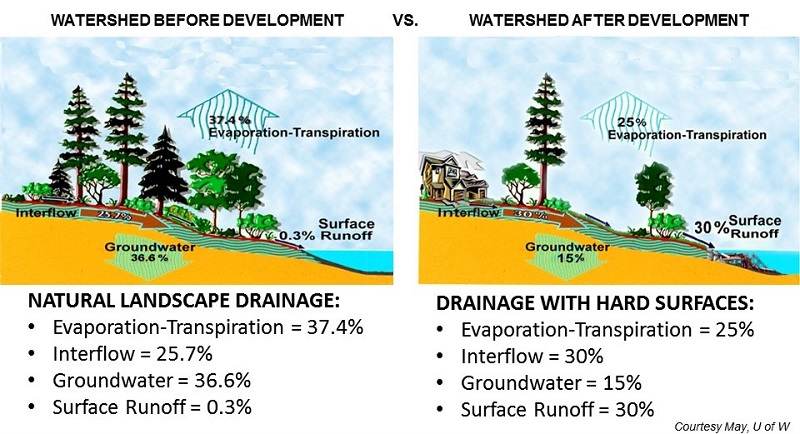
We know that developed surfaces means less plants and trees and less spongy soil to absorb the water where it falls. The water cannot seep into the ground and recharge the groundwater. Less plants and trees also:
- Reduces the amount of water released into the atmosphere (and water cycle) through evapotranspiration.
- Reduces natural cooling.
- Reduces the vegetation’s ability to slow rain drops.
- Reduces the ability to naturally filter pollutants
Raindrops that hit hardscapes and cannot soak into the ground (runoff) will move faster and are more likely to erode and collect pollutants as they run off into river or toward groundwater. The same hard surfaces often retain heat more than natural areas. This is known as the Urban Heat Island effect. The warm surfaces can change the temperature of the water flowing across them as they head toward streams and rivers and the critters living in them. Rivers need to maintain their normal temperature to stay healthy – just like people.
Exercise
Using the data from the image above, predict three ways these changes could impact the watershed, water cycle or flooding in the area?
Managing Stormwater
As you may have guessed, increased runoff has been a problem since people started living in cities. There are some consequences that come from all those hard (impervious) surfaces being crammed so close together. One of the effects (as seen in the graphic above) is how water moves above and below the ground. Instead of the natural landscape acting like a sponge to absorb the rainwater as it falls, all those hard surfaces change where the water can go and how it flows.
Now, we’ll walk you through some of the infrastructure facilities we use to manage this challenge and some newer, greener ways of managing stormwater runoff that you can spot around Bend.
 Not the Same as Sewer Pipes
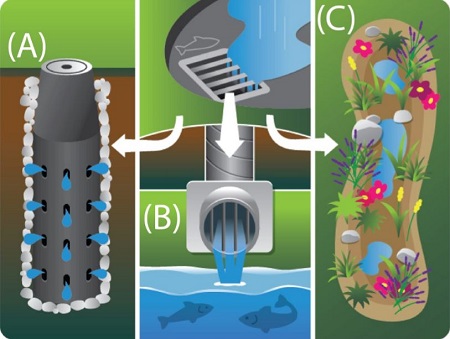
Bend has over (how many) storm drains throughout the city. Every storm drain connects to pipes that lead to either:
(A) underground “injection” facilities
(B) the Deschutes River without treatment
(C) landscape facilities (see graphic at right)
Remember: Bend’s stormwater system is entirely separate from wastewater/sewer pipes. Stormwater is NOT treated at the Water Reclamation Facility (WRF).
Minimizing Impacts: Stormwater as a Resource
In Lesson 1, you learned that stormwater runoff is the greatest threat to our waterways. You also made a list specific things you can do to help. Cities are also working on ways to reduce negative impacts to our watershed with Low Impact Development (also known as green infrastructure) systems that are designed to allow water to drain more like it did naturally, before the trees and soil were cleared away and the hard surfaces were built. We now know that development projects can be designed to put stormwater to good use.
- Select one of the two short videos below. One is from the city of New Orleans. The other is from the United Kingdom.. Both explain how well-designed green infrastructure systems can better manage their stormwater. Many cities around the world are now using improved stormwater management systems that not only prevent flooding, but can be less expensive that traditional pipes, improve water quality and create better places to live.
- As you watch the video you selected, pick three of the examples that could improve your neighborhood or school.
Green roofs, bioswales, bioretention ponds, and even native trees are a few key examples of local green infrastructure. Below is a list of their benefits.
- Green roofs can retain 40 percent of stormwater hitting rooftops.
- Bioswales and retention ponds can absorb water and channel or hold excess run-off. Even just planting extra trees, which consume (and evapo-transpire) water, can help. Evergreens and conifers were found to intercept 35 percent of water hitting them.
- Green infrastructure can also lower air temperatures, which is crucial in cities facing the Urban Heat Island effect.
(Sources: U.S. Environmental Protection Agency and American Society of Landscape Architects)
Take a virtual or in-person look at examples of better ways to build that help protect our water quality by downloading “Bend’s Better Site Design Walking Tour”.
We can all make choices to protect our water. Bend is improving how our city manages stormwater. As our city grows, new development can be designed and built with green infrastructure in place from the start. Each person can start new simple habits that add up to make a big difference. We all play a part in improving stormwater and keeping our water clean.
Exercise
Write down three ways you and your family can reduce the impacts. If you need a quick review, watch this video.
Bonus Exercise
Create a 30 second video and enter it to win cash prizes in the One Water Student Video Contest.
Congratulations, you have completed Lesson 2!
In Lesson 3, we will dive deeper into an important part of our water’s journey and learn how wastewater/sewage from our homes and schools is cleaned and returned to the water cycle.
Learning Objectives
- To understand what happens to used water after it goes down the drains inside your home and school.
- To know the two environmentally safe products left at the end of the Water Reclamation Facility cleaning processes.
- To be able to explain the role of microorganisms in the wastewater cleaning process.
- To take action and only flush the three P’s.
Vocabulary List
- Wastewater: Used water (sometimes called sewage) that flows down indoor drains in homes, schools and businesses.
- Wastewater (sewer) Collection System: All the wastewater/sewer pipes and pumps that collect and transport the used water from our homes, schools and business to the Water Reclamation Facility (WRF) for treatment.
- Water Reclamation Facility (WRF): Where Bend’s dirty/used water is “reclaimed” to be processed, cleaned, tested and safely returned to the water cycle.
- Pathogens: Bacteria, virus, or other microorganism that can cause disease.
A Quick Review about Pipes
Are stormwater and wastewater pipes separate?
Yes. Wastewater pipes only collect the used wastewater from our homes and businesses, conveying it to the Water Reclamation Facility where the wastewater will be cleaned.
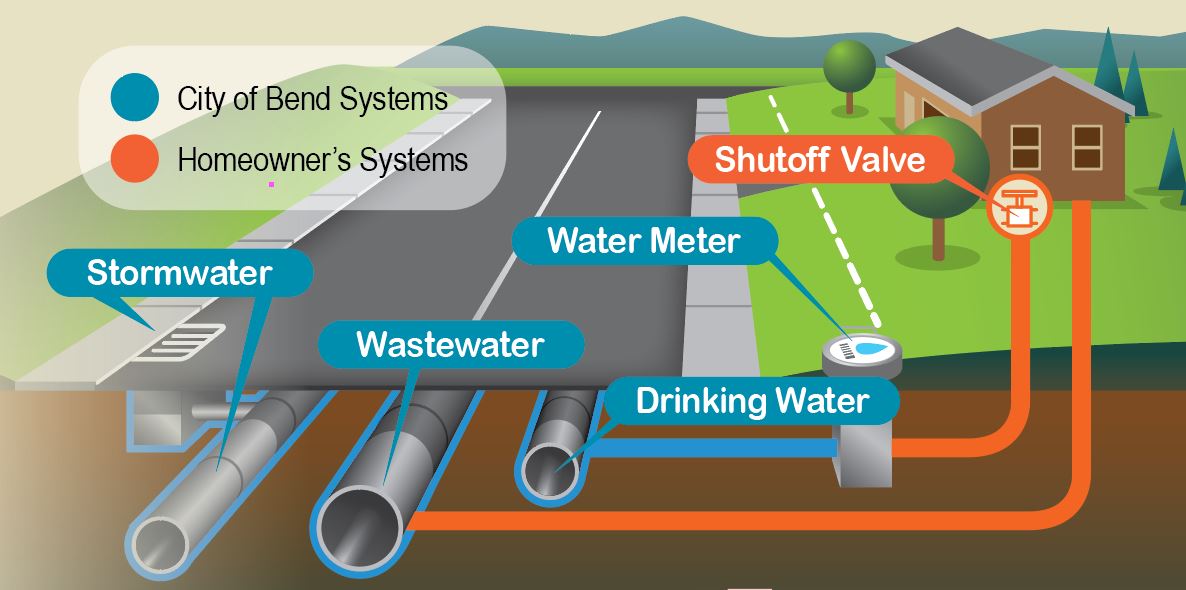
Where Does the Used Indoor Water Go?
About half the water delivered to homes and businesses ends up going down the drain. Remember during the previous lesson, your drawing included clean water pipes going into buildings and wastewater pipes going out of buildings. The used water that flows down indoor drains, mostly in kitchens and bathrooms, is called wastewater. Think about what goes down the drain where you live?
Wastewater collection and treatment processes are engineered and built to keep us safe from pathogens in wastewater that could make us sick. Once the wastewater leaves your home’s pipes, it goes through the long maze of underground pipes and pumps called the wastewater collection (sewer) system out to the Water Reclamation Facility (WRF). The WRF takes the dirty water and, through a series of processes, will filter, clean, disinfect, test, and then return the cleaned water safely back into the water cycle.
Exercise
As you watch the virtual tour video below, note the words appearing in large circles. Write an explanation of why you think those words are highlighted; why are they being called out and what are you supposed to remember.
Find and write down:
- Two (2) environmentally safe products.
- Four (4) things removed to avoid clogged pipes and sewer backups.
Check your answers:
- The two environmentally safe products are: safe water and biosolids.
- The big cloggers are: grease, food, trash and disposable wipes.
A wastewater treatment plant is basically a good bug factory!
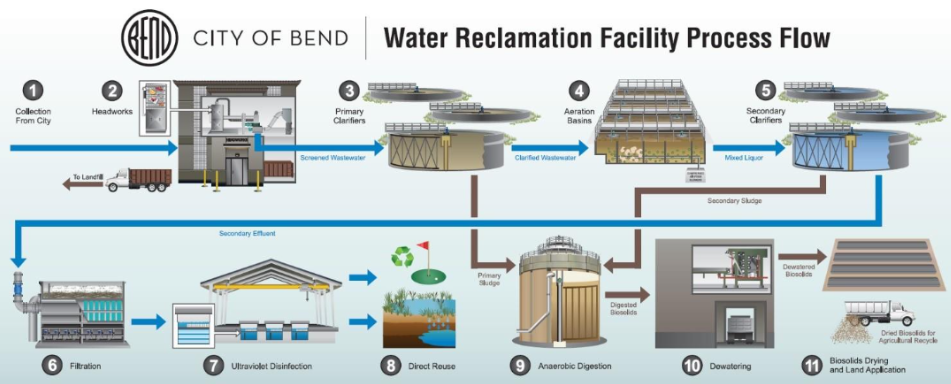
The wastewater treatment process consists of physical and biological treatment. The first part of the process physically removes solids by means of sedimentation, or separation by gravity. Biological treatment uses microorganisms and is effective at removing both solid and dissolved organic matter.
Wastewater Treatment
Microorganisms are used in aeration basins to metabolize (eat and digest) the organic matter (waste material) and converting them to carbon dioxide, water and energy.
Biosolids
Microorganisms also metabolize the solid organic matter, before it is dried and then used on crops in Central Oregon. Our biosolids in Bend are “Class A”, which means they can be used by the general public.
Exercise
Let’s be scientists! This experiment will let you observe why we don’t use toilets as trash cans. You will need a few supplies and a safe place to complete the exercise. Click on the link below for instructions.
Avoid the Cloggers
 Our wastewater collection and treatment system were designed and built to collect three things along with our used water: pee, poop and paper (also known as the Three P’s). The experiment helped to show why only toilet paper should go into the toilet. Even similar products, like tissues and wipes can clog pipes. Watching the WRF tour video, you learned No Food, no Trash, no Grease, no wipes belong in the wastewater. We always want to keep wastewater pipes flowing in the right direction. Nobody wants a sewage back up – yuck!
- Wipes clog pipes. Throw them in the trash.
- Scrape food scraps into compost bins or the trash, not the sink disposal.
- Cool fats, oils and grease and dispose of it in the trash.
- Put all trash into the trashcan.
Watch this animated video from Australia – Aussies only flush the Three P’s too!
Wastewater treatment processes are engineered to keep us safe and mimic nature in many ways. The WRF returns the cleaned water to the water cycle by recycling water then releasing it to percolation ponds, where the water molecules will join the water cycle by percolating down in to the ground toward our aquifer or evaporating into the atmosphere. It keeps us safe from pathogens that could make us sick and returns cleaned water safely back to the environment.
Take Away Question
What is something you learned today that you would teach someone to help keep our sewers flowing?
Congratulations, you have completed Lesson 3!
In Lesson 4, we will explore water supply and water use. Increases in human population cause increases in consumption of natural resources. We will learn how to be WaterWise and use water efficiently.
Learning Objectives
- To understand water is a vital and limited resource.
- To be able to explain why Bend is an arid climate.
- To be able to analyze water use indoors and outdoors to determine ways to conserve the most water.
- To take actions to conserve water (which can also reduce energy use).
Vocabulary List
- Arid: A climate having little or no rain.
- Rain Shadow: A region having little rainfall because mountains block rain-producing weather systems and cast a “shadow” of dryness behind them.
- Xeriscape: Landscaping method developed especially for arid and semi-arid climates that utilizes water conservation techniques.
- Plant Water Need: Amount of supplemental water assigned to landscape plantings that is needed to maintain plant health.
- Native Plants: Plants that originated in a particular geographical region and therefore able to survive with little or no supplemental irrigation.
A Quick Review of Our Water Resources
We depend on rain and snowfall high in the Cascade Mountain Range to recharge our water sources. Our surface water source from the Bend Municipal Watershed is our primary supply all year. When water demands increase during the summer because of outdoor landscape watering, groundwater must be pumped from the Deschutes Regional Aquifer to supplement our surface water supplies. Bend uses these two water supply sources to meet peak season demand and use during emergencies.
Water on Earth
There is no life without water. You know the amount of water on earth is all there will ever be. Watch this brief TED Ed video of the earth’s distribution of water. Take note of how much of earth’s usable water available to us.
Why Use Water Wisely?
You know we have excellent water quality in Bend. However, the amount of water we have access to is limited. Managing our water wisely and carefully planning for the future is vital. Although it’s true that the water cycle continuously returns water to Earth, it is not always returned to the same place, or in the same quantity or quality. When water sources get polluted, they are more expensive to treat. Growing populations can put a strain on water systems and supplies, and building more water systems to meet peak demand is very expensive. Using water efficiently will help ensure reliable water supplies and can delay or reduce the need for building new systems.
 Indoor Water Use
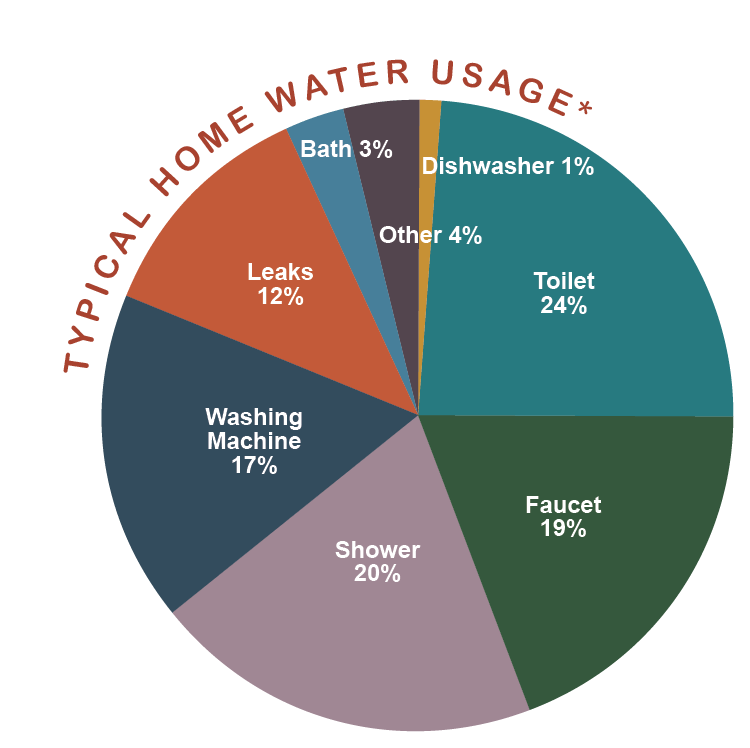
To use water more efficiently, we need to know how much water we use and where we use it. The chart to the right shows how a typical home uses water. Which slices are the largest? Think about how many times a day you use a toilet, shower or faucet. Most likely, that means there are plenty of opportunities to use less.
If you look at how much water is wasted from leaks alone, doesn’t fixing water leaks seem like a no-brainer?
- Watch the video below and list the 10 water saving tips in your journal.
- Imagine a day where you had to carry around all the water you use. Watch this funny video and using your 10 tips list, put a check mark by all the ways this guy could be using less water throughout his day. Note any other ways to use less water that the 10 tips list did not include.
- Write down three actions that would save the most water indoors in your home.
Outdoor Water Use
 That guy was hauling around a lot of water. But, it only represented his indoor water use! 60 percent of our home water use in Bend is used outside. Where do you think all that outdoor water use is going?
If you said watering yards and landscapes, you are right.
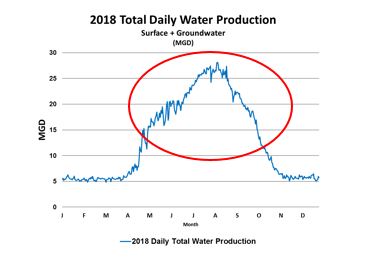
In Bend, we use more water outdoors in the summer months. It’s called peak demand and it is expensive. The graph above shows that water use in Bend skyrockets during the summer season. Saving water outdoors is where efforts to use water more efficiently can result in big water savings. As Bend grows, using less water can even postpone the need to build expensive water systems just to meet that peak demand.
Since we know that huge amounts of water is sprinkled, sprayed or dripped onto lawns and landscapes during the summer season, it can be a great opportunity to save even more water.
Here are a few ways that can make a big difference:
- Sweep, don’t spray your driveway and sidewalks. (This helps our stormwater too.)
- Use a shut off nozzle on hoses.
- In the winter, when moving snow off your sidewalks and driveway, blow or shovel the snow into your landscape where it can melt slowly into the ground. Your plants will love you for it! (This reduces stormwater runoff too.)
- Using climate appropriate (or native) plants and trees, sensible use of lawns, efficient use of irrigation sprinklers, and mulching to maintain moisture around plants. Some people call this Xeriscaping. You can call it smart…and beautiful.
Look at the graphic below and note how different plants need different amounts of water.
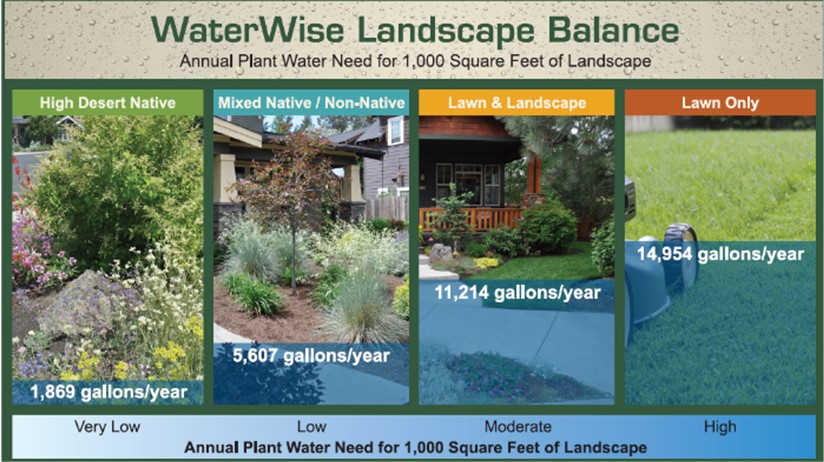
Watch this 2016-2017 PSA Video Contest winning video from Napa Watershed to see some examples of Xeriscape in other arid communities.
By using less water, we create an opportunity for water to be used elsewhere. Our population in Bend is growing, and new water rights and infrastructure are expensive. By using less, we can stretch water supplies further into the future. This helps us to ensure there will be water in Bend throughout our lifetime and for future generations.
While working on this lesson about water conservation, did you notice any connection to our watershed? Watch this video clip and complete the exercise below.
Exercise
During a previous lesson, we learned about stormwater runoff and green infrastructure features that keep our watershed healthy. Some features can also turn stormwater into a resource that helps to reduce water use outdoors. List two stormwater features that catch stormwater runoff to water plants.
Optional Exercise
If you have an outdoor sprinkler system, watch this video from Denver Water with your parents and take note of the three important checks of watering season.
It’s All Connected
Our journey through Bend’s water cycle started in the mountains and traveled to the Bend Municipal Watershed, from the intake to treatment (and pumping wells in the warmer months), then delivering clean water to homes and schools. Then, after the water is used inside, it is collected and treated until it is safe to be returned to the water cycle. We’ve learned that what we do with our water at home and in school matters to our watershed and water cycle. Here’s your chance to see how we use water matters in businesses too, if we want to keep Bend our little slice of heaven on earth.
Exercise
Assume the role of the restaurant owner as you watch the video below. Write down the 10 tips and put a check mark by any that can reduce negative impacts to our watershed and help protect our water. List three reasons using these tips would be important to your business. Put a star by any tips that you can also use at home.
Congratulations! You have completed Lesson 4.
Thank you for taking this water journey from the forest to your faucet and back again. Please complete the post-survey below to complete this series.
Want to learn even more about our water? The following resources expand on what we’ve learned.