Automated Traffic Enforcement Program
In 2024, City Council directed the Bend Police Department to implement an Automated Traffic Enforcement Program with a desire to help make our streets safer and reduce vehicle crashes.

This program uses cameras to detect people who run red lights or drive too fast at various intersections around Bend. It is expected to be underway by April 2026.
The Bend Police Department is working with Verra Mobility to implement this program. Verra Mobility delivers smart transportation solutions for safer, easier, and more connected mobility. The Bend Police Department has identified several intersections where cameras will be installed in Spring 2026. We will keep you posted each step of the way.
Citations
Where do I mail my payment?
Mail your cashier check, money order or personal check payable to the City of Bend, along with the tear-off portion (Section A) in the enclosed envelope. Make sure the payment side shows through the envelope window. Do not mail cash. Write your citation number on your payment.
Bend Municipal Court
555 NE 15th Street
Bend, OR 97701
Do you have other questions about your citation?
Call the Bend Municipal Court at 541-388-5572, Monday-Friday, 9 a.m. to Noon and 1 p.m. to 4 p.m. (except holidays).
Frequently Asked Questions
It means using cameras to detect drivers who break traffic laws. Red light cameras take pictures and video of vehicles that don’t stop at red lights. Speed cameras take pictures of vehicles going too fast. If someone driving a vehicle breaks the rules, the registered owner of the vehicle gets a ticket in the mail. Automated traffic enforcement is designed to improve the community’s safety by cutting down on traffic violations and crashes.
We want to make our streets safer and reduce vehicle crashes. Community members in Bend routinely say that traffic safety is an important issue. This program helps us respond to those concerns.
According to the National Highway Transportation Safety Administration, 29 percent of all traffic fatalities in vehicles are the result of speed-related crashes. And in 2019, more than 127,000 people were hurt in crashes caused by running red lights.
Our traffic team works hard, but there aren’t enough officers to be everywhere. Right now, we have two officers focused on driving under the influence, three traffic officers, and one traffic sergeant. Cameras will patrol certain busy intersections all the time, so officers can focus on crashes, hit-and-runs, and provide enforcement in an increased capacity.
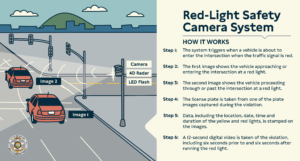
- Red light cameras monitor vehicles as they approach intersections. They take pictures and short videos if a vehicle runs a red light. The cameras watch the traffic lights and work with sensors that keep track of vehicles near the crosswalk or where vehicles stop.
- Speed cameras use radar to check how fast a vehicle is going. If it’s going 11 miles per hour or more over the speed limit, the camera takes pictures of the vehicle, the people inside, and the license plate. A computer records all the details.
- Running a red light is a violation of ORS 811.265 (driver’s failure to obey a traffic control device) which is a Class B traffic violation and can lead to a $265 presumptive fine. That includes coming to a full stop before turning right at a red light.
- Speeding fines identified by photo enforcement are the same as other speeding tickets, set by ORS 811.109 and dependent on how fast you’re going:
- 11–20 mph over: this is a Class C violation with a $165 presumptive fine.
- 21–30 mph over: this is a Class B violation with a $265 presumptive fine.
- 31+ mph over: this is a Class A violation with a $440 presumptive fine.
A technician and a Bend Police officer will check each incident before sending a ticket. If you get one, it will arrive in the mail within two weeks.
In Oregon, these tickets are treated like regular moving violations, so they might affect your car insurance.
Police will compare the photo from the camera to ensure a match with the registered owner of the vehicle’s Oregon DMV photo and description. If it doesn’t match, they probably won’t send a ticket. If you get a ticket but weren’t driving, you can complete a sworn affidavit under penalty of law affirming that you are not the driver pictured in the citation. The Municipal Court will review the affidavit and decide what to do next.
The process will work just as it does for all traffic violations and other infractions at the Bend Municipal Court. You’ll get a court date and instructions with your ticket. You’ll need to go to court and tell the judge if you want to contest it. Please read your citation carefully.
Verra Mobility will handle all installation, configuration, service, and support. It may also handle all processing, printing, mailing, and customer support.
Even though we’ll need more staff to run the program, we expect that money from tickets will eventually cover those costs to prevent cost to the City.
No. This program is about safety, not raising money. People in Bend have asked for better traffic enforcement, and this is one way we’re responding.
The system is designed to be cost neutral. Cost neutral means the system pays for itself, so the City doesn’t have to spend extra money to keep it running. Any money from tickets will go into a special fund for future traffic safety projects, education, and enforcement.
We plan to place cameras at the intersections of: NE 27th and Neff Road, SE Reed Market and Third Street, and SE Powers Road and Third Street. Additional locations are under consideration. Oregon law says we must put up signs before each intersection with a camera, so drivers will have a warning.
Verra Mobility will be responsible for checking and adjusting the cameras every day to make sure they’re accurate.